
You’ve received word that it’s time for teacher observations: cue anxiety and panic. The jitters are real, especially if this is your first year as a teacher, and your first formal observation ever. Take a deep breath and relax.
I’m here to give you ten simple tips to help you have a successful classroom observation. If you take the time to implement a few of these suggestions, you’ll certainly be more prepared for your observation . These tips are geared toward K-2 teachers, but they’re useful for any teacher needing a refresher on how to prepare for an excellent observation. Be sure to read all the way to the end and grab the free reflection sheet.

If this is your first observation of the year or your first year teaching, it’s best to do a lesson that you are familiar with or a lesson that you can test drive. Choose a topic that you feel especially comfortable with and a topic that you know your students will enjoy. Sometimes the best lessons are the simplest ones. Don’t overdo it.
In my first year of teaching, I made the mistake of trying to do a fancy, over the top lesson, which turned out to be an utter disaster. All you need to know is that it ended up with students lying on the floor making snow angels in their clean clothes. Can you imagine how embarrassed I was? I was literally sweeping up fluffy little snow foam off the floor. My principal said she never wanted to see such a thing again. Do yourself a favor, and keep it simple.

While you don’t want to overdo it, you also don’t want to do an impromptu lesson for a formal observation. That’s never a good idea. I’m not sure a teacher would ever think to do this, but I just had to put it out there. You definitely need a thorough plan for what you are going to do during that 30-45 minute observation period.

If you are required to post your lesson plans on the door or objectives on the wall, you want to make sure all those things are up to date, especially during your observation. It’s not the best look when your administrator walks in, and the date on your board says, August 15, 2019 instead of the correct date. I’m just saying…
Make sure your objectives are current for the day and lesson plans are up to date. It’s also nice to see current student work on display.

Okay, we all forget to do attendance from time to time; maybe every day, actually. However, observation day is not the day to forget the attendance.

Not only does this throw you off, but it distracts from the lesson, distracts your students and you’ll probably get the side-eye from your administrator. Make a special reminder about attendance and stick it on your desk the night before your observation.

It’s always a good idea to let your team or other teachers close in proximity to you, know the time and date of your observation. By letting others know about your observation, you prevent certain distractions such as them sending over that one student that always comes over with a folder (you know that one student). It also prevents your teacher pals from popping in for a random “Hey, how’s it going?” moment during this time. On this same note, you may also want to turn the ringer down on your phone so your phone is not ringing during your observation.

Make sure your students go to the restroom 15-20 minutes before your observation.
Doing a restroom break with the whole class will help minimize the hands that go up during the observation. Once one hand goes up, we know that it usually spirals into several students asking for a restroom break. Prevent that by first taking everyone to the restroom at one time and then making an announcement that there will be no more restroom or water breaks until after the lesson. Of course, if there are special circumstances, then you adjust as you see fit for your class.
In addition, I usually do a little “wiggles out” session with my students. This is where they can stand up, jump around, high five their friends, do their little jiggle dance, and get it all out before we get down to serious business. They usually think its funny and snicker about it.

You’ll know in advance when your observation is taking place. Take the opportunity to review classroom rules and expectations with your students.
How do we sit in our chairs? Where are our hands when supplies are on the table? How do we transition from the carpet to our small groups ? What if we need to use the restroom? What tone of voice do we use when…? How do we conduct ourselves when we have visitors?
Classroom management is so important and its definitely the time to prove that you have a great handle on the flow within your classroom. Apart from the actual lesson, I want to say that your classroom management will be the next important thing that your administrator will be looking at. Make the review a fun one. Role-playing is a great way to have fun reviewing rules and expectations. My kids would love when I played like I was the principal popping open the door to observe them. We would then talk about what I saw and talk about what could be improved. Definitely do a review of rules and expectations prior to your observation.

I always let students sharpen 1 or 2 pencils to place on their desks. During observation, they don’t go into pencil cases, pouches, bags, boxes or anything else. Also, copies for activities should already be prepped and ready to go. Count to make sure you have enough for every student. You won’t have any time to run down to the copy machine.

Look, when it’s all said and done, your observation should be a regular day in your classroom. Administrators are coming to see your awesomeness on display and to get ideas they can share in the next PD meeting. Many times they want to see your unique talents and abilities in getting content to your students. This is your time to shine.
To knock the nervousness, try leading off with some fun attention grabbers and make note of how your principal is involved.
Example: “Macaroni and cheese… Everybody freeze! Does everyone see how principal M is frozen?”
All your kids will turn around to look, everyone giggles and you continue with your amazing lesson. Pose open-ended questions so that your students get an opportunity to show their thinking. Make sure everyone has an opportunity to respond. Liven up! Enjoy the lesson. If you are enjoying and having fun teaching, everyone else will hop on the train.

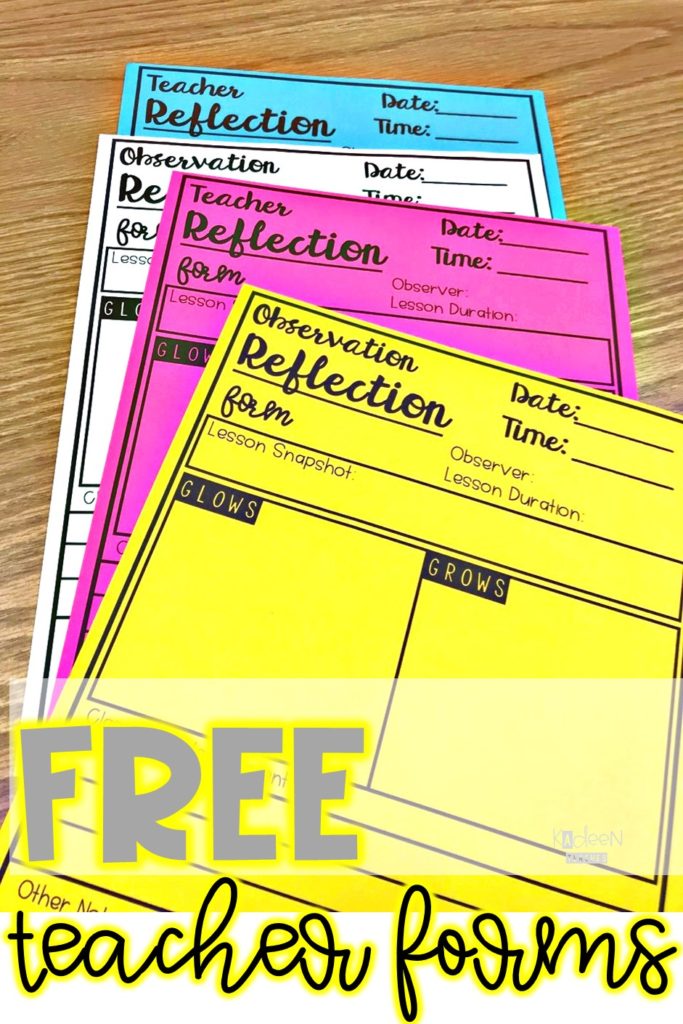
Observations are all about glowing and growing.
After your observation, reflect on how you think it went. Were you too nervous? Did you get everything executed in the time frame? Were your students enjoying the lesson ? Could your lesson have been a bit more engaging? Reflecting on your practice is important for your growth and it will also help you to set goals for your next observation.
Don’t be hard on yourself if you don’t feel as if your observation went the way you intended. There’s always room for improvement, but be confident and know that you are a strong, capable teacher. One observation does not define you. Pat yourself on the back for those glows and get ready to put in the work for those areas where you need growth. Certainly your scope of knowledge and abilities extends beyond the 30-45 minute snippet of an observation, so don’t dwell on the negative. Sometimes we are our own worst critic. If you don’t think you did as well as you needed to, this is your time to focus on how you can do better next time.
I know how important self-reflection is to your professional growth, so I have created a free post-observation reflection sheet that you can use just to jot your thoughts down. Be sure to grab those reflection sheets. Store a reflection sheet in a binder each time you are observed so that you have a visual of your improvements. Here’s to rocking those observations !
It’s good to know that you should avoid unplanned lessons when there will be a classroom observation. I usually plan out my entire week in a general format and then figure it out as we go to some extent. I will be sure that I have an engaging lesson planned for my next observation.